Zodiac Signs Dates: Complete Western and Vedic Chart for Indian Readers
Born on a cusp date and confused whether you are Aries or Mesha? You are not alone. Questions around zodiac signs dates are especially common in India, where one website may call you Aries while your family pandit says your Rashi is Meena or Mesha. Both answers can be correct, but they come from different astrological systems.
This guide brings both charts together in one place. You will see the Western Sun-sign dates, the Vedic Rashi dates, the reason they differ, and what each sign traditionally means. We will also cover Moon sign, Nakshatra, elements, ruling planets, and how to find the right sign for your birth details. Grounded in Jyotish concepts, this is meant to clear confusion, not add to it.
Introduction: Why Zodiac Sign Dates Confuse So Many Indians
Imagine a person born on 12 April. A global lifestyle site says Aries. A temple astrologer checks the panchanga logic and says Meena until around 13 or 14 April in many years. The family gets puzzled, the WhatsApp group starts debating, and nobody is sure which answer to trust. This is one of the most common astrology confusions Indian readers face.
Most people searching for zodiac signs dates want a simple birth-date chart. That part is easy. The confusion begins because two different systems are often mixed together online. Western astrology usually uses the Tropical zodiac, tied to the equinoxes and seasons. Vedic astrology, or Jyotisha, uses the Sidereal zodiac, called Nirayana, which tracks the signs against the fixed stars.
That difference shifts the date ranges by roughly 23 to 24 degrees, which translates into many people getting a different sign name depending on the system used. In India, this matters because daily rashifal, naming traditions, matchmaking, muhurta, and many panchanga-based practices rely more on Rashi and Nakshatra than a magazine-style Sun sign.
Below, you will find a side-by-side chart, quick traits, symbols, elements, ruling planets, and practical guidance on what to use and when. If Google says one sign but your family pandit says another, both may simply be speaking different astrological languages.
What Are Zodiac Signs? A Simple Explanation of the 12 Signs
The zodiac is a belt of 12 equal divisions along the ecliptic, the apparent path of the Sun through the sky. These signs are not random personality labels. They are a structured celestial framework used to interpret time, temperament, and planetary placement.
In the Western tradition, the zodiac developed through Babylonian and Greek astronomical-astrological systems. In Indian astrology, the same 12-sign framework appears as the Rashi Chakra, the wheel of signs used in Jyotisha. The names are familiar once you place them side by side: Aries (Mesha), Taurus (Vrishabha), Gemini (Mithuna), Cancer (Karka), Leo (Simha), Virgo (Kanya), Libra (Tula), Scorpio (Vrischika), Sagittarius (Dhanu), Capricorn (Makara), Aquarius (Kumbha), and Pisces (Meena).
Each sign has a ruling planet, element, symbol, and specific qualities. The dates tell you where the Sun was by sign in a given system, but a full birth chart also considers the Moon, Lagna, Nakshatra, and the grahas.
Zodiac Signs Dates Chart: Western vs Vedic (Side-by-Side)
This is the section most readers save. If you only want a quick zodiac sign dates chart, use the table below. The Western column shows standard Tropical dates used by most international astrology websites. The Vedic column shows approximate Sidereal Rashi dates commonly followed in Indian astrology.
| Sign | Sanskrit Name | Western Tropical Dates | Approx. Vedic Sidereal Dates |
|---|---|---|---|
| Aries | Mesha | Mar 21 to Apr 19 | Apr 14 to May 14 |
| Taurus | Vrishabha | Apr 20 to May 20 | May 15 to Jun 14 |
| Gemini | Mithuna | May 21 to Jun 20 | Jun 15 to Jul 16 |
| Cancer | Karka | Jun 21 to Jul 22 | Jul 17 to Aug 16 |
| Leo | Simha | Jul 23 to Aug 22 | Aug 17 to Sep 16 |
| Virgo | Kanya | Aug 23 to Sep 22 | Sep 17 to Oct 17 |
| Libra | Tula | Sep 23 to Oct 22 | Oct 18 to Nov 16 |
| Scorpio | Vrischika | Oct 23 to Nov 21 | Nov 17 to Dec 15 |
| Sagittarius | Dhanu | Nov 22 to Dec 21 | Dec 16 to Jan 13 |
| Capricorn | Makara | Dec 22 to Jan 19 | Jan 14 to Feb 12 |
| Aquarius | Kumbha | Jan 20 to Feb 18 | Feb 13 to Mar 14 |
| Pisces | Meena | Feb 19 to Mar 20 | Mar 15 to Apr 13 |
Western Tropical Zodiac Dates
These are the date ranges most global websites use: Aries: Mar 21 to Apr 19, Taurus: Apr 20 to May 20, Gemini: May 21 to Jun 20, Cancer: Jun 21 to Jul 22, Leo: Jul 23 to Aug 22, Virgo: Aug 23 to Sep 22, Libra: Sep 23 to Oct 22, Scorpio: Oct 23 to Nov 21, Sagittarius: Nov 22 to Dec 21, Capricorn: Dec 22 to Jan 19, Aquarius: Jan 20 to Feb 18, and Pisces: Feb 19 to Mar 20.
Vedic Sidereal Rashi Dates (Approximate)
For Indian readers, these Vedic zodiac signs dates are often more relevant: Mesha roughly Apr 14 to May 14, Vrishabha May 15 to Jun 14, Mithuna Jun 15 to Jul 16, Karka Jul 17 to Aug 16, Simha Aug 17 to Sep 16, Kanya Sep 17 to Oct 17, Tula Oct 18 to Nov 16, Vrischika Nov 17 to Dec 15, Dhanu Dec 16 to Jan 13, Makara Jan 14 to Feb 12, Kumbha Feb 13 to Mar 14, and Meena Mar 15 to Apr 13.
These are approximate because ayanamsha choice and exact solar ingress timing can shift dates slightly. Lahiri ayanamsha is the most widely used standard in India.
Quick Note: Why These Dates Can Shift Slightly in 2024–2025
A one-day change can happen around Sankranti boundaries. Leap year effects, time zone differences, and the exact moment the Sun enters a sign all matter. In Indian calculations, Lahiri ayanamsha is commonly used, but software settings may differ. So if you were born near midnight on a transition date in 2024 or 2025, it is smart to verify the exact ingress instead of relying only on a static date chart.
Get Your Free Horoscope on Astroha
Why Is My Zodiac Sign Different in Indian Astrology?
This is the question behind most searches on zodiac signs dates from Indian users. The short answer is that Western and Vedic astrology anchor the zodiac differently. One follows the seasonal starting point of Aries. The other tracks the zodiac against the fixed stars.
Tropical (Sayana) vs Sidereal (Nirayana)
Western astrology generally uses the Tropical, or Sayana, zodiac. Its zero Aries begins at the spring equinox. Vedic astrology uses the Sidereal, or Nirayana, zodiac, which accounts for the precession of the equinoxes and keeps the signs aligned with the stellar backdrop. Put simply, Western astrology follows the seasons, while Vedic astrology follows the fixed stars. That is why a late-March birth is often Aries in Western astrology but still Meena in Vedic reckoning.
What Classical Jyotisha Texts Say
Classical Jyotisha texts do not present a modern internet-style date table, but they do provide the framework behind Rashi-based calculation and interpretation. Brihat Parashara Hora Shastra discusses the rashis, grahas, their qualities, rulerships, and their role in chart judgement. Surya Siddhanta is central to traditional astronomical calculation, especially for planetary and solar positions. Texts such as Phaladeepika and Saravali build interpretive depth around signs, houses, and graha results. So the difference is not a social-media debate. It rests on long-standing astronomical and astrological methods within separate traditions.
Sun Sign vs Moon Sign (Rashi): Which One Matters More in India?
In many Indian households, your Moon sign matters more in day-to-day astrology than your Sun sign. That surprises people who grew up reading newspaper columns that divide everyone into 12 Sun signs. In Jyotisha practice, the Moon reflects mind, emotional pattern, receptivity, and lived experience. It is therefore central to many transit-based predictions.
Sun Sign in Western Astrology
Your Sun sign is the sign occupied by the Sun on your date of birth. This is the sign used by magazines, apps, and most pop-astrology content. It is useful for broad personality themes, confidence style, and how you express your core identity.
Moon Sign (Janma Rashi) in Vedic Astrology
Your Moon sign, or Janma Rashi, is the sign where the Moon was placed at birth. This is the Rashi many Indian astrologers use for daily rashifal, transit effects, naming patterns, and marriage compatibility. Families often ask, “Bacche ki rashi kya hai?” and they usually mean the Moon sign, not the Sun sign.
Nakshatras: The Deeper Layer Beyond Zodiac Dates
The 12 rashis are further divided into 27 Nakshatras, or lunar mansions. This is where Indian astrology becomes far more precise than date-only sign reading. Two people may both be Karka, but if one is born in Pushya and another in Ashlesha, their temperament and life emphasis can differ sharply. For naming, muhurta, and compatibility, Nakshatra is often indispensable.
The 12 Zodiac Signs in Order: Dates, Traits, Symbols, Elements and Ruling Planets
Here is a quick reference to the 12 zodiac signs in order, with both English and Sanskrit names. Dates are shown in Western and approximate Vedic form so you can compare easily.
Aries (Mesha)
Western: Mar 21 to Apr 19. Vedic: Apr 14 to May 14. Symbol: Ram. Element: Fire. Ruler: Mars. Aries or Mesha carries initiating force, courage, and impatience. Bold like the energy of Chaitra beginnings, this sign likes action more than waiting for committee approval.
Taurus (Vrishabha)
Western: Apr 20 to May 20. Vedic: May 15 to Jun 14. Symbol: Bull. Element: Earth. Ruler: Venus. Vrishabha is grounded, comfort-loving, and reliable. Think of someone who values good food, steady income, and quality over showy noise.
Gemini (Mithuna)
Western: May 21 to Jun 20. Vedic: Jun 15 to Jul 16. Symbol: Twins. Element: Air. Ruler: Mercury. Mithuna is curious, quick-witted, and communicative. This sign often behaves like the person in the family who knows every cousin’s update before anyone else.
Cancer (Karka)
Cancer zodiac dates: Jun 21 to Jul 22 in Western astrology, Jul 17 to Aug 16 in Vedic approximation. Symbol: Crab. Element: Water. Ruler: Moon. Karka is emotional, protective, and family-first. Home, memory, and belonging matter deeply here.
Leo (Simha)
Western: Jul 23 to Aug 22. Vedic: Aug 17 to Sep 16. Symbol: Lion. Element: Fire. Ruler: Sun. Simha radiates leadership, pride, and visibility. Even in a crowded room, this sign tends to occupy the emotional center-stage.
Virgo (Kanya)
Western: Aug 23 to Sep 22. Vedic: Sep 17 to Oct 17. Symbol: Maiden. Element: Earth. Ruler: Mercury. Kanya notices what others miss. Practical, analytical, and detail-focused, this sign can turn chaos into a neat spreadsheet or a perfectly managed household list.
Libra (Tula)
Western: Sep 23 to Oct 22. Vedic: Oct 18 to Nov 16. Symbol: Scales. Element: Air. Ruler: Venus. Tula seeks fairness, beauty, and relationship harmony. It has a natural instinct for balance, whether in design, diplomacy, or daily give-and-take.
Scorpio (Vrischika)
Western: Oct 23 to Nov 21. Vedic: Nov 17 to Dec 15. Symbol: Scorpion. Element: Water. Ruler: Mars. In some later interpretive traditions, Ketu is also linked with Scorpio. Vrischika is intense, private, and transformative. This sign rarely does anything in half-measures.
Sagittarius (Dhanu)
Western: Nov 22 to Dec 21. Vedic: Dec 16 to Jan 13. Symbol: Archer. Element: Fire. Ruler: Jupiter. Dhanu seeks wisdom, meaning, and direction. Dharma, philosophy, teaching, and long-distance horizons often feature strongly in its nature.
Capricorn (Makara)
Western: Dec 22 to Jan 19. Vedic: Jan 14 to Feb 12. Symbol: Sea-goat. Element: Earth. Ruler: Saturn. Makara values structure, responsibility, and patient achievement. It resembles the person who quietly builds a career over years while others chase quick applause.
Aquarius (Kumbha)
Western: Jan 20 to Feb 18. Vedic: Feb 13 to Mar 14. Symbol: Water-bearer. Element: Air. Ruler: Saturn. In some later interpretive traditions, Rahu is also linked with Aquarius. Kumbha is independent, future-minded, and unconventional, often drawn to big systems, social ideas, and unusual paths.
Pisces (Meena)
Western: Feb 19 to Mar 20. Vedic: Mar 15 to Apr 13. Symbol: Fish. Element: Water. Ruler: Jupiter. Meena is intuitive, imaginative, and spiritual. It absorbs atmosphere easily and often carries a poetic or devotional streak.
The Four Elements of the Zodiac and What They Mean
If you want to understand sign behavior quickly, start with the elements. Elemental grouping explains the basic style of response long before you memorise every trait list.
Fire, Earth, Air and Water Signs
Fire signs are Aries, Leo, and Sagittarius. They act, initiate, and express energy outwardly. Earth signs are Taurus, Virgo, and Capricorn. They stabilise, build, and focus on tangible reality. Air signs are Gemini, Libra, and Aquarius. They think, connect, and exchange ideas. Water signs are Cancer, Scorpio, and Pisces. They feel, protect, and respond intuitively.
Elements are one reason two signs can clash or click immediately. A fiery person may move quickly, while a watery one senses before speaking. Neither is better. They simply process life differently.
Zodiac Symbols and Glyphs: What Each Sign Represents
Zodiac symbols compress myth and meaning into one image. Aries is the ram, showing charge and momentum. Taurus is the bull, linked to strength and steadiness. Gemini uses the twins for duality and exchange. Cancer is the crab, protective and indirect. Leo is the lion, royal and solar. Virgo is the maiden, tied to purity and discernment.
Libra alone uses an object, the scales, for balance and justice. Scorpio is the scorpion, alert and defensive. Sagittarius appears as the archer, aiming beyond the immediate. Capricorn’s sea-goat looks unusual because it combines ambition with depth. Aquarius is the water-bearer, pouring knowledge or life force. Pisces shows two fish moving in linked but different directions, a fitting symbol for spiritual and emotional complexity.
Is There Really a 13th Zodiac Sign? Ophiuchus Explained
Every few months, social media revives the claim that there is a 13th zodiac sign called Ophiuchus. The astronomy part is true in one sense: Ophiuchus is a real constellation that lies along the ecliptic path. But astrology does not build the zodiac by copying every constellation exactly as it appears in the sky.
Traditional astrology divides the zodiac into 12 equal 30-degree signs. That system remains the basis of both Western and Vedic practice. So while Ophiuchus exists astronomically, it is not used as a standard sign in the classical 12-sign zodiac. This is a good example of the difference between astronomy, which maps physical constellations, and astrology, which uses a symbolic and mathematical zodiac framework.
How to Find Your Correct Zodiac Sign from Your Birth Date
If you are asking, “What is my zodiac sign?”, first decide which answer you want. For a general Western Sun sign, your birth date is usually enough unless you were born on a cusp day. For a Vedic answer, especially Rashi or Nakshatra, date alone is not always sufficient.
If You Only Want Your Western Sun Sign
Use your birth date and compare it with the standard Tropical date ranges. If you were born near a transition date like 20 March, 19 April, or 22 December, check the exact year and time zone because cusp births can flip depending on the Sun’s ingress timing.
If You Want Your Vedic Rashi and Nakshatra
For accurate Indian astrology, you need three details: date of birth, exact time of birth, and place of birth. The Moon changes signs faster than the Sun, and Nakshatra boundaries can shift within hours. This is why many families preserve the hospital birth time carefully. A proper calculation gives you Sun sign, Moon sign, Lagna, and Nakshatra, which is far more useful than a generic date chart.
Zodiac Signs in Everyday Indian Life: Festivals, Muhurta and Matchmaking
In India, signs are woven into daily and ritual life in ways many Western articles do not capture. A child’s name may be chosen from the syllable linked to the birth Nakshatra. Matchmaking often checks Rashi, Nakshatra, Guna Milan, and sometimes Mangala Dosha before marriage talks move ahead. Muhurta selection for griha pravesha, marriage, travel, or business opening can also depend on lunar factors rather than just Sun-sign identity.
Regional calendars add another layer. In Tamil tradition, solar month transitions are closely observed, so Mesha Sankranti and other solar ingresses carry cultural weight. In North Indian panchanga practice, lunar tithi and Moon placement often dominate practical electional use. Makara Sankranti is perhaps the most visible public example of a sign ingress festival. Kumbha symbolism also appears in the Kumbha Mela, where the zodiac is not abstract at all, but part of sacred timekeeping.
That is why rashi dates in astrology matter differently in India. They are not just entertainment. They can touch naming, ritual timing, compatibility, and family custom.
Get Your Exact Sun Sign, Moon Sign and Nakshatra with Astroha’s AI Astrology
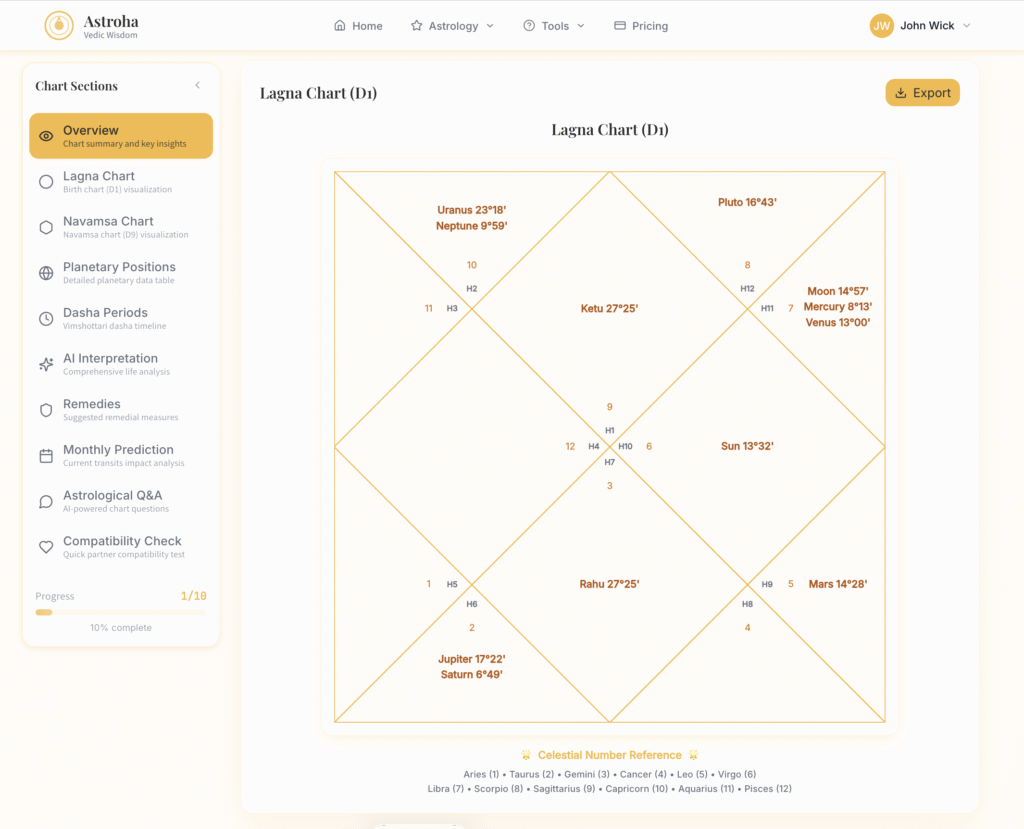
Date charts are useful, but they are still a shortcut. If your birth falls near a transition, or if you want more than a generic sign label, a full calculation is the better route. With Astroha’s AI astrology tools, you can enter your birth date, time, and place to get your exact Sun sign, Moon sign, Lagna, and Nakshatra in minutes.
That matters because personalized astrology is built from your actual chart, not from a broad sign category shared by millions of people. Astroha combines AI speed with Jyotisha-informed logic, giving Indian users a more practical bridge between tradition and technology. If you have ever felt that popular sign descriptions fit only halfway, your full chart will often explain why.
What to Do Next After Finding Your Zodiac Sign
Knowing your sign is only step one. Real astrological insight begins when you connect that sign to the rest of your chart and to the area of life you care about.
5 Simple Next Steps
- Confirm your Western Sun sign from the date chart.
- Calculate your Moon sign or Janma Rashi using exact birth details.
- Find your Nakshatra to understand temperament, naming, and compatibility.
- Check your Lagna for deeper personality and life-direction clues.
- Read a personalized horoscope instead of relying only on general sign traits.
Frequently Asked Questions About Zodiac Signs Dates
What are the 12 zodiac signs in order?
The 12 zodiac signs in order are Aries, Taurus, Gemini, Cancer, Leo, Virgo, Libra, Scorpio, Sagittarius, Capricorn, Aquarius, and Pisces. In Sanskrit they are Mesha, Vrishabha, Mithuna, Karka, Simha, Kanya, Tula, Vrischika, Dhanu, Makara, Kumbha, and Meena.
What is the zodiac sign for a specific date?
It depends on which system you are using. A date like 10 April is Aries in Western astrology, but in Vedic astrology it is often still Meena until the Sun enters Mesha around 13 or 14 April. Transition dates need extra care.
Is there a 13th zodiac sign?
Not in the traditional zodiac used by astrology. Ophiuchus is a real constellation, but Western and Vedic astrology both use 12 equal zodiac divisions for sign calculation and interpretation.
Why is my zodiac sign different in Indian astrology?
Indian astrology usually uses the Sidereal zodiac, while most popular global astrology uses the Tropical zodiac. Because these systems start from different reference points, the sign dates shift, and many people receive different sign names in each system.
What are the personality traits of each zodiac sign?
Each sign has broad tendencies such as Aries being action-oriented, Taurus steady, Gemini curious, Cancer caring, Leo expressive, Virgo analytical, Libra balanced, Scorpio intense, Sagittarius idealistic, Capricorn disciplined, Aquarius unconventional, and Pisces intuitive. Still, your full chart gives a far more accurate picture than sign traits alone.
Does the date of a zodiac sign change every year?
Usually not by much, but exact ingress timing can create slight yearly variation. In Vedic astrology especially, one-day shifts near Sankranti dates can happen depending on ayanamsha, year, and time zone.
Related Astrology Topics You May Also Like
If this topic sparked your curiosity, the next useful areas to explore are Janma Kundli, Moon sign calculation, Nakshatra meanings, zodiac compatibility, Mangala Dosha, Mahadasha timing, and the daily Panchanga. Date-based astrology is the doorway. Chart-based astrology is where the detail lives.
Final Take: Use the Right Zodiac Date System for the Right Purpose
When people argue over zodiac signs dates, they are often comparing two valid systems without realising it. The Western chart is helpful for identifying a general Sun sign and reading mainstream astrology content. The Vedic chart is more relevant for many Indian practices involving Rashi, Nakshatra, transit reading, matchmaking, and muhurta.
The best question is not, “Which one is true?” It is, “Which system am I using, and for what purpose?” Dates are a good starting point, especially if you just want a quick sign answer. But if you want something accurate and personal, use your full birth details and calculate the complete chart.
This article is for informational and spiritual guidance purposes. For major life, medical, legal, or financial decisions, please consult a qualified professional alongside any astrological insight.
Ready to Discover Your zodiac signs dates?
Get personalized insights with Astroha’s AI tools.